



You publish content regularly. Your pages get indexed. Some even get traffic. Yet rankings stay flat, impressions plateau, and competitors with “less content” keep outranking you.
This is a common issue seen in real SEO audits. The problem usually isn’t backlinks or authority. It’s how well each page communicates its value to search engines and users.
On-page optimization directly influences how Google understands your content, selects titles and snippets, evaluates relevance, and connects pages across your site. With Google’s Search Generative Experience and AI-driven result summaries, clarity at the page level matters more than ever.
From hands-on work with business websites, blogs, and service pages, one thing is consistent: sites that improve website seo effectively focus on strong on-page seo optimization before chasing advanced tactics. This guide explains how to do that properly.
What Is On-Page SEO and Why Does It Matter for Website Ranking?
On-page SEO optimization is the process of improving individual web pages so search engines can better understand their content, relevance, and structure. It matters because clear titles, headings, internal links, URLs, and content help Google evaluate relevance, which directly impacts your ability to improve website ranking consistently.
On-page SEO refers to everything you control directly on a page, including:
- Page titles and meta descriptions
- Headings (H1–H6)
- URL structure
- Internal links and anchor text
- Images and alt text
- Content quality and clarity
According to Google’s Search Essentials, search systems rely on prominent on-page signals to understand what a page is about. These signals help Google decide:
- Whether your page is relevant to a query
- Which text to use for titles and snippets
- How pages relate to each other internally
In real projects, pages with similar backlink profiles often rank very differently simply because one page communicates its topic more clearly through on-page structure.
How Does On-Page SEO Help Improve Website SEO Over Time?
On-page SEO helps improve website seo over time by making pages easier to crawl, clearer to interpret, and more aligned with search intent. Well-optimized pages reduce confusion for search systems, improve snippet quality, and support long-term visibility through seo-friendly content rather than short-term ranking spikes.
On-page optimization compounds over time because:
- Google can crawl and interpret pages more efficiently
- Content aligns better with what users are actually searching for
- Titles and snippets are more likely to be generated accurately
Google may rewrite page titles and meta descriptions if the page structure is unclear or misleading. Pages with consistent headings, focused topics, and clear summaries are more likely to maintain stable SERP presentation.
From practical audits, pages that receive ongoing on-page improvements often see gradual gains in impressions and click-through rate without acquiring new links.
On-Page SEO Optimization Checklist (Core Elements)
Google uses multiple signals to generate title links, including the HTML title tag, headings, and prominent on-page text.
Best practices include:
- One clear, descriptive title per page
- Avoiding keyword stuffing or unnecessary branding repetition
- Writing meta descriptions that summarize the page accurately
Meta descriptions do not have a fixed length. Google may use them or generate snippets from page content depending on relevance.
Header Tag Optimization (H1–H6)
Headers provide structural clarity for both users and search engines.
Effective header usage includes:
- One clear H1 that reflects the main topic
- Logical H2 and H3 hierarchy
- Avoiding repeated or competing headings
Google guidance emphasizes clarity. Pages with multiple equally prominent headings can confuse title and snippet generation.
URL Structure SEO Best Practices
Google recommends URLs that are:
- Simple and human-readable
- Logically organized
- Descriptive of the content
Good URLs help both users and search engines understand page context before content is loaded. Use hyphens for word separation and avoid unnecessary parameters where possible.
What Are the Most Effective On-Page SEO Techniques in 2026?
The most effective on-page seo techniques in 2026 focus on people-first content, clear page structure, descriptive internal linking, and accurate on-page signals. These best practices for websites help search systems understand context, support AI-generated results, and improve long-term ranking stability.
Modern on-page SEO prioritizes clarity over manipulation.
High-impact techniques include:
- Matching content precisely to search intent
- Using descriptive headings and internal links
- Writing content for humans first, not algorithms
- Structuring pages so key information is easy to identify
In real-world testing, pages optimized for clarity consistently outperform pages optimized only for keyword density.
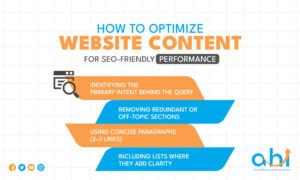
How to Optimize Website Content for SEO-Friendly Performance
To optimize website content, focus on intent alignment, readability, and structure. SEO-friendly content answers real questions clearly, uses short paragraphs, logical headings, and avoids filler that dilutes topic relevance.
Google’s helpful content guidance emphasizes usefulness and reliability.
Effective content optimization involves:
- Identifying the primary intent behind the query
- Removing redundant or off-topic sections
- Using concise paragraphs (2–3 lines)
- Including lists where they add clarity
From experience, improving content structure often increases engagement metrics even without changing the word count.
Image Optimization SEO – Why It’s More Than Just File Size
Image optimization seo improves accessibility and search understanding by using descriptive file names and meaningful alt text. Properly optimized images help Google interpret page context and improve user experience without relying on keyword stuffing.
Google recommends:
- Writing alt text that describes the image’s purpose
- Avoiding keyword-stuffed or generic alt attributes
- Using empty alt text for decorative images
Images should support the content, not distract from it. In audits, poorly written alt text is one of the most common on-page issues.
Internal Linking for SEO – The Most Overlooked Ranking Lever
Internal linking for seo helps Google discover pages, understand site structure, and distribute relevance signals. Descriptive anchor text and logical internal connections improve crawlability and strengthen topical relationships across your website.
Google relies on links to find and understand pages.
Best practices include:
- Linking related pages naturally
- Using descriptive anchor text instead of “click here”
- Supporting content clusters through internal links
For example, linking a blog post to a relevant service page helps reinforce topical relevance without external links.
Common On-Page SEO Mistakes That Hurt Website Rankings
Common issues seen in audits include:
- Keyword stuffing in content or alt text
- Duplicate titles and meta descriptions
- Thin pages created only to rank
- Poor internal linking structure
- Ignoring mobile readability
These issues reduce clarity and can cause Google to rewrite titles or ignore intended signals.
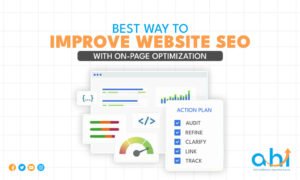
Best Way to Improve Website SEO with On-Page Optimization
The best way to improve website seo is to follow a structured on-page seo checklist: audit existing pages, clarify titles and headings, align content with intent, strengthen internal links, and refine continuously based on performance.
Step-by-Step Action Plan
- Audit your most important pages
- Fix titles, headings, and URLs
- Optimize content clarity
- Improve internal linking
- Monitor impressions and CTR
Conclusion
On-page optimization is not a one-time task. It’s a process of making your pages easier to understand, easier to trust, and easier to rank.
Key takeaways:
- Clarity beats complexity
- Structure supports relevance
- Content quality compounds over time
If your goal is to improve website seo sustainably, focus on optimizing what you already have before chasing new tactics.
FAQs
What is the fastest way to improve website SEO?
The fastest improvements usually come from fixing titles, headings, internal links, and content clarity. These on-page seo optimization changes help Google interpret pages more accurately without waiting for new backlinks.
How often should on-page SEO be updated?
On-page SEO should be reviewed whenever content changes or performance drops. Regular updates help maintain seo-friendly content and adapt to evolving search intent.
Is on-page SEO enough to rank on Google?
On-page SEO alone does not guarantee rankings, but it is essential. Without strong on-page signals, even authoritative sites struggle to improve website ranking consistently.
Does image optimization really affect SEO?
Yes. Image optimization seo improves accessibility and helps Google understand page context, which supports overall content relevance.
What is the difference between on-page SEO and technical SEO?
On-page SEO focuses on content and page elements, while technical SEO addresses site-wide infrastructure like crawling, indexing, and performance. Both work together.
Ready to Improve Your Website’s SEO with On-Page Optimization?
Ready to improve your website’s SEO with clear, effective on-page optimization? Start refining your pages today and turn existing content into consistent traffic and visibility gains.
If you need expert support or a detailed on-page SEO audit, connect with Abu Hasan Lavlu for a professional consultation and actionable recommendations.